In The Free Workshop That Started Everything, I wrote about how an affordable workshop gave me a way into robotics at BRAC University. I also briefly mentioned that Hirok, Sakib, and I later began teaching robotics ourselves. By The Robot That Took Me to India, that small group was already helping with projects, rebuilding robots, and travelling to exhibitions.
This story sits between those two points. It is about how we started teaching before we felt fully ready, then kept removing the barriers that made robotics difficult to enter.
We were not ready, but that was not the point
After finishing Hirok's free workshop, I proposed that we organize more workshops together. My friend Sakib was interested too. Hirok was not convinced that we were ready to teach.
He had a fair reason. We had only recently started learning robotics ourselves. Teaching meant taking responsibility for other students, answering questions, and designing something structured enough that complete beginners would not become lost.
I told him that the reason I had not entered robotics earlier was simple: it was too expensive for me. I was sure there were many other students with the same problem. Robotics was already an expensive hobby. Charging them a large workshop fee before they even knew whether they enjoyed it only made the entrance harder.
I also admitted that I was not ready to teach advanced robotics. But I was good at programming, and I already helped friends with it. Freshers, meaning first-year students, who had never built a robot or were completely new to programming did not need rocket science. We only needed to start by tapping into their curiosity.
A blinking LED was enough.
An Arduino is a small programmable board. It is much less powerful than a personal computer, but it can read sensors, control lights, move motors, and interact with the physical world. For someone seeing it for the first time, writing a few lines of code and watching an LED blink could feel surprisingly powerful.
That was the point. We did not need to teach everything. We needed to help students build one small thing and start asking what else they could make.
I also had one useful quality as a teacher: I had no problem admitting that I did not know something. When a student asked a question I could not answer, I simply said so. Then I learned it and came back with an answer in the next class. I never believed teaching required pretending to know everything.
Hirok agreed to try.
Convincing him was only one part of making the workshops happen. Narjis was not teaching with us, so she may seem absent from this story. In reality, she was helping from behind the scenes as the vice president of the Robotics Club of BRAC University, usually called ROBU. BM Abir was the club president at the time. He was also active in robotics, although he was not part of our teaching group, and he supported the work from the club leadership side.
Getting university approval for workshops was rarely simple. What looked to us like a smooth process often involved rooms, schedules, paperwork, and difficult conversations with management. Narjis handled those fights so smoothly that we barely noticed them, with Abir supporting the effort as president. We could focus on lessons and students because they were quietly clearing the path in front of us.
Designing for actual students
The three of us designed the workshop around the lives students actually had. BRAC University followed an open-credit system, which meant students from the same batch could choose different courses and end up with completely different class schedules. Some were free in the morning, others in the afternoon, and others only later in the day. We had classes too.
A single fixed time would have excluded many students and made the workshop difficult for us to maintain. As far as I remember, we created nine small sections. Hirok, Sakib, and I each taught three sections at different times. Students could attend whichever slot suited them.
We kept the batches small so we could help people directly. Robotics is difficult to learn by watching someone else connect wires from the other side of a crowded room. Beginners need to touch the components, make incorrect connections, see things fail, and ask questions without feeling that they are slowing down an entire hall.
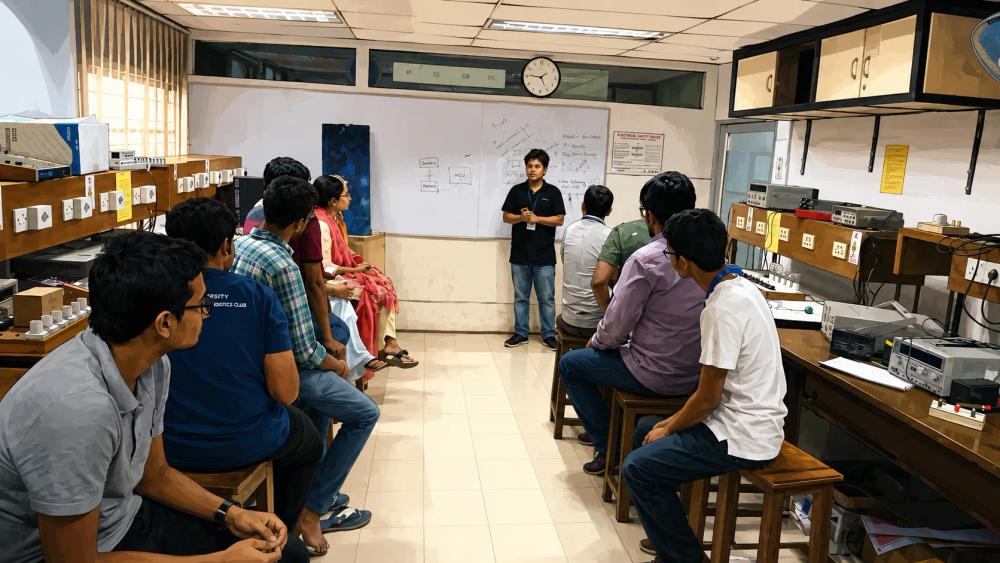
There was no workshop fee. Students only paid for the components, which they could continue using afterward.
The lessons were structured almost like a small university course, but much more practical. We started with blinking an LED, then created patterns with several LEDs. Students learned to read an infrared sensor, measure distance with an ultrasonic sensor, make sound with a buzzer, and control a motor through a motor driver.
Those small exercises could be combined into larger ideas. A few lights could become a model smart home or a small city-lighting system. A light sensor could switch a lamp on when the room became dark. A distance sensor could turn something on when a person approached.
We taught students how to connect and control the components, but we tried not to tell them exactly what they should build. Once someone understood how to read a sensor and control an output, the project was their decision. We did not want our examples to become the limits of their imagination.
Robotics spread through the club
The strategy worked better than we expected. By the end of one semester, students were building things, asking questions, and enjoying the process. More importantly, robotics was no longer limited to the R&D department.
ROBU had several departments. Creative designed posters and banners. Events handled planning and logistics. HR worked on recruitment and coordination. Traditionally, only the R&D members were expected to build robots.
After the workshops, people from every department understood at least the basics. I started thinking of it as the robotics literacy rate of the club. We had increased it.
A Creative member could design a poster and also understand the robot being advertised. Someone from Events could arrange a competition while knowing what participants were trying to build. Robotics became part of the club rather than something hidden inside one technical department.
Along the way, we met Sayantan Roy Arko through one of our first two workshop batches. He was a junior from EEE who later moved to CSE. Before joining us, he mostly worked on robotics by himself, which is what I mean when I call him a lone wolf. He was also one of the most naturally capable mechanical builders I had met. Give him a mechanical problem and he could usually find a way to build something that worked.
He was energetic, practical, and comfortable turning rough ideas into physical structures. Once he joined us, he became probably the most adored junior in our group. He was also the best singer in the club. Over time, he started working with us and later helped teach the very first robotics activity at the Residential Semester. The group that began with Hirok, Sakib, and me was slowly becoming larger, with newer students learning from us and then contributing skills of their own.
The workshops also gave us confidence. The format continued until my final semester and carried on afterward. But once we saw that it worked, we started noticing other barriers. Then we tried to remove those too.
Starting before buying hardware
The first few workshop classes were still difficult for complete beginners. For some students, the transition from writing code on a screen to controlling something in the physical world was confusing. They had to understand programming, electronic components, wiring, and the behaviour of the circuit at the same time.
Hardware also created another entry cost. A student might be curious about robotics but not curious enough yet to buy a full set of components.
So, with very little preparation, I created a short Bangla robotics tutorial series on YouTube using an online simulator. It gave beginners a way to start without buying an Arduino, sensor, motor, or breadboard. They could write code, connect virtual components, and watch the simulated circuit respond.
After uploading the tutorials, I realized I had done something more useful than I expected. There were already some Bangla robotics tutorials online, but many were difficult for beginners to follow. The audio was unclear, the camera did not show the components properly, or important steps were skipped.
About a year later, I began seeing many more Bangla tutorials with clear explanations, better audio, and easier demonstrations. I cannot claim that my videos caused all of that. But they helped me understand that I did not have to create every tutorial myself. Once enough people started sharing what they knew, the community could continue the work.
Taking robotics to the Residential Semester
BRAC University had a Residential Semester, usually called RS. Students moved to a separate campus, lived there for the semester, and learned to manage life away from their families.
The semester was not only about academic courses. Students also selected an activity that taught something different. Depending on what was available, that could include cooking, gardening, yoga, filmmaking, debating, or other practical and creative activities.
Our team also pushed to include robotics in RS. The university rejected the idea at first. We kept trying, and roughly two semesters later it was accepted. BM Abir played an important role in pushing it forward, and Arko helped us teach the first robotics activity there. That brought a different group of students to us, including people outside the usual engineering crowd.
By then, a curious BRAC University student could find robotics in several places: through ROBU, one of our workshops, the free online simulator, or the Residential Semester. We still did not want to force anyone into it. Our message was simple: if you are curious, come and try.
Making competitions less intimidating
Workshops solved the first barrier, but competitions exposed several new ones. Consider a line-follower competition, where a small robot has to follow a marked path around a track. The basic idea sounds simple. For a fresher, almost nothing about it is simple.
They may not know what the competition environment will look like. They may not know which infrared sensors to buy, which motors will work, how to build the chassis, or how the robot should decide whether to turn left or right.
Even testing creates a problem. A proper line-follower track requires space. Most students cannot spread a large printed track across their homes and leave it there while repeatedly adjusting a robot.
So we began arranging short preparation workshops before competitions. At first, Hirok, Sakib, and I taught them ourselves. Later, students from previous workshops and competitions joined us and helped teach the next group.
The club printed practice tracks and provided space for testing. We explained the available components, basic algorithms, mechanical choices, and common mistakes. This was also where someone like Arko was especially valuable. He could make the mechanical parts feel practical rather than mysterious.
Students could build together, test against each other, and learn what a real competition might feel like. They no longer had to begin from nothing.
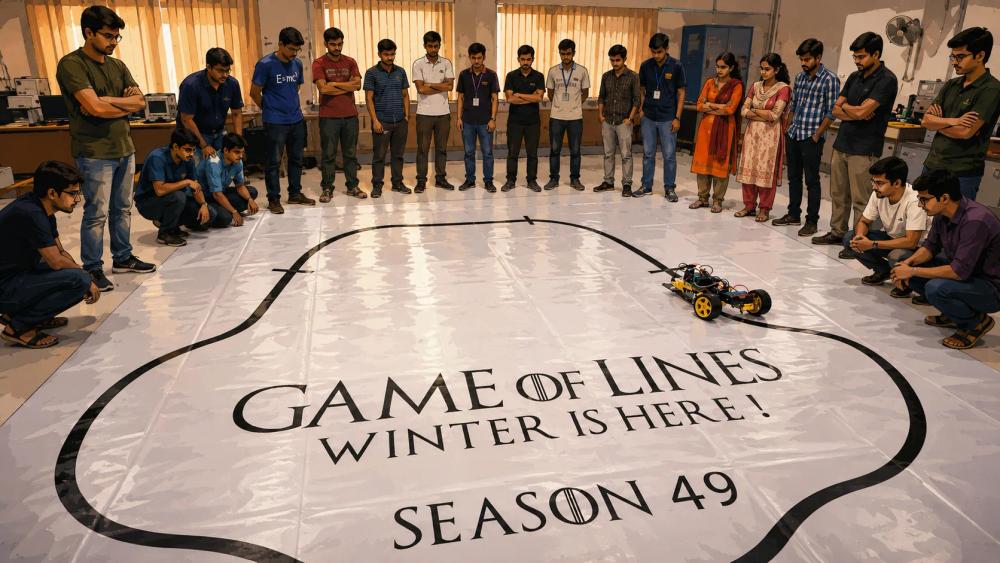
But we were careful not to show them a complete implementation. We wanted them to explore. We wanted their robots to fail, because failure was where most of the useful learning happened.
The challenge was controlling the size of that failure. It had to be difficult enough that they needed to think and try again, but not so difficult that they decided robotics was not for them. Good enough to keep trying. Not bad enough to leave.
People Began Recognizing Our Work
While we were focused on workshops, tutorials, competitions, and components, something else was happening in the background. People were beginning to know us.
Students came to us before competitions, when side projects stopped working, or when they simply did not know where to begin. Teachers also asked us to help students with course projects and thesis work.
At the time, I did not think much about what that meant. I only knew that people recognized our work, trusted us enough to ask for help, and remembered us whenever something involving robotics came up.
I enjoyed that more than I expected. Not the attention itself, but the feeling that the work we were doing had become useful to other people.