In my previous post, The Free Workshop That Started Everything, I wrote about how a free robotics workshop changed the direction of my university life at BRAC University. It introduced me to Hirok, who became my technical mentor, and Sakib, who would become one of my closest friends. At the time, I thought I had simply found a new hobby. I had no idea it would eventually take me to another country.
Introducing Narjis
There was one more person I briefly mentioned at the end of that story: Narjis Mostofa.
Narjis was from Hirok's batch. She started in ECE before later moving to EEE, and she was one of the smartest people I met during university. What impressed me most was her leadership. She could organize people, run events, and somehow keep everyone moving toward the same goal.
Some friendships begin in classrooms. Ours began with robots, competitions, and a senior I never had any intention of promoting to my batch.
By then, university life had become wonderfully busy. Hirok, Sakib, and I were regularly running robotics workshops. We were also helping students with projects, experimenting with new hardware, and spending countless evenings surrounded by Arduino boards, motors, wires, and unfinished ideas.
I was still officially part of the creative department of the Robotics Club. Whenever there was a workshop, competition, or university event, I was usually the one designing the posters, banners, and promotional materials. This was long before AI tools could generate designs from a prompt. Everything was done manually.
Rebuilding WALL-E
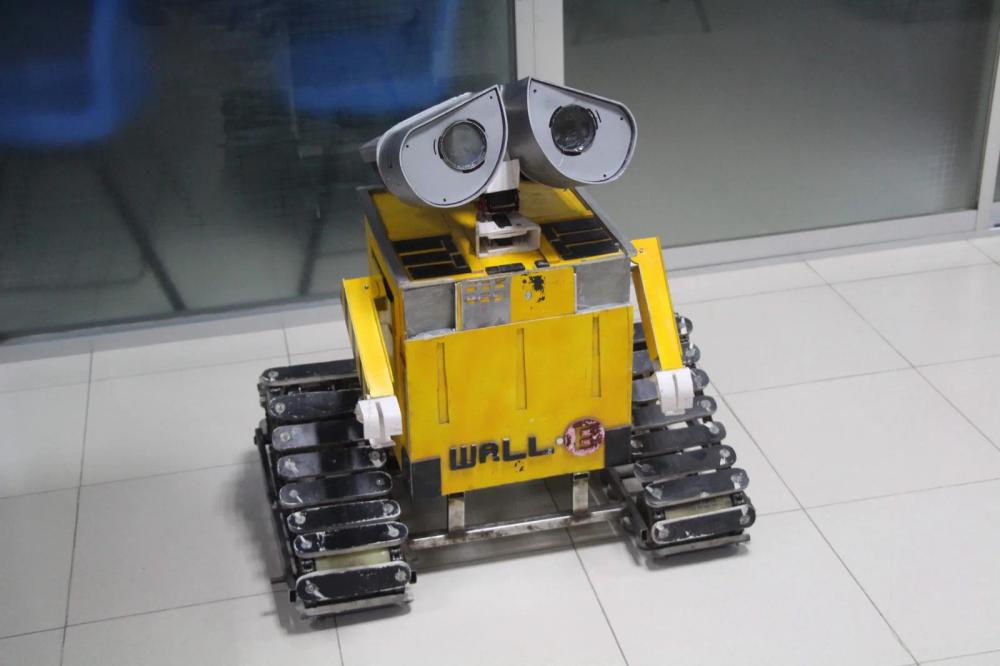
Around that time, Narjis and her team chose to rebuild one of the Robotics Club's most loved projects: WALL-E.
The original robot had been built by seniors several years earlier. As they graduated, different batches maintained it. It was not a competition robot. We brought it to exhibitions, university events, and school visits because people loved it.
Children would stand in line to shake its hand. Adults who had never cared about robotics would stop and watch it greet people. At the time, a robot that could move around, wave, and interact with visitors felt almost futuristic.
WALL-E had travelled to India before. In 2015, it appeared with BRACU ROBU at IIT Bombay's Techfest.
Like most student-built robots around us, it had been made using whatever parts were available.
WALL-E moved using automotive window motors, which we simply called glass motors. They were strong enough to move its heavy, tank-like chassis. The difficulty was current. When one of those motors stalled or pushed against an obstacle, it could draw far more current than an ordinary Arduino motor driver could safely handle. The earlier design therefore used relays, electrically controlled switches capable of handling larger loads.
The control system had another problem. It still lived on breadboards connected with colorful jumper wires. Breadboards are useful for prototypes, but unreliable for a heavy robot repeatedly transported between events. Wires came loose, connections failed, and someone often had to repair the robot before a demonstration.
Narjis and her team selected WALL-E as a course project and decided to rebuild the electronics properly.
Hirok, Sakib, and I helped them understand the existing hardware, calculate the expected current draw, redesign parts of the circuit, and replace the temporary breadboard setup with proper PCB boards.
This was Narjis's project, and her team built it. We helped when they got stuck. That was how our club worked. Seniors helped juniors, friends helped friends, and everyone learned something along the way.
The rebuilt WALL-E became much more reliable. It started appearing at club events again without everyone worrying that a loose wire would end the demonstration halfway through. As far as I remember, Narjis and her team received an A, and the project became one of the highlights of the course.
The invitation
Then our club advisor, Dr. Md. Khalilur Rahman, received an invitation from IIT Kanpur in India. As far as I remember, the event was Techkriti, IIT Kanpur's annual technical festival. They wanted BRAC University to bring WALL-E and showcase it there.
Suddenly, the robot rebuilt inside a university lab in Dhaka was about to cross an international border.
Two members from Narjis's project team and two members from the Robotics Club's R&D side were selected. Hirok was an obvious choice. Narjis would represent her team, and Kanchi, another member of the project team, joined her.
Even though I officially belonged to the creative department, people around the club and several faculty members already knew me through the workshops, technical projects, and club activities. To my surprise, I was selected as the fourth member.
Sakib had contributed to rebuilding WALL-E too, but there were only four available spots. He could not join us, and I remember feeling bad that he was missing from the team.
For me, the opportunity did not feel real. A couple of years earlier, I could not afford most robotics workshops. Now I was about to travel to another country to represent my university with a robot I had helped rebuild, with every expense covered.
The visa rush
We barely had a week to prepare. WALL-E needed final testing, paperwork had to be completed, funding had to be arranged, and all four of us needed Indian visas.
Funding took longer than expected, leaving us with only a couple of days before departure to submit our applications. None of us had travelled abroad before, so every hour without an update felt significant.
Hirok and Kanchi received their visas first. Narjis and I did not. By noon on the following day, we were convinced we were not going.
Tickets were purchased for Hirok and Kanchi, and they prepared to fly the next morning. Narjis and I tried to accept that at least part of the team would still reach India.
Just before the embassy closed, we were told to collect our passports. We expected disappointment. Instead, we found visas inside.
The excitement lasted only a few minutes. There were no seats left on the flight Hirok and Kanchi were taking.
The organizers at IIT Kanpur refused to give up on us. They found another route and assured us they would get us there somehow. We received tickets for an evening flight to Kolkata, followed by another flight to Lucknow the next morning.
The wrong visa
While checking the visas, I noticed everyone else's passport contained a note saying something like "Attending conference in Lucknow." Mine did not.
Naturally, instead of asking whether that was normal, I picked up a pen and wrote it myself. I genuinely thought someone had forgotten.
Narjis and I flew to Kolkata that evening. At immigration, an officer stopped me and explained that I was allowed to stay in India for only three days, including the day I arrived. I had received a transit visa, not a conference visa.
The officers were confused because my passport also said I was attending a conference in Lucknow. Narjis started arguing that the visa clearly showed the purpose of our trip.
I took her aside and quietly admitted that I had written that line myself. She looked at me in complete disbelief.
The immigration officers were kind and offered to contact the embassy. I asked them not to. During my first trip abroad, I did not want to create an international paperwork problem over something I had added with a pen. I had watched enough episodes of Banged Up Abroad on Discovery Channel to imagine how badly that could end.
I accepted that I would present WALL-E and then leave early. There would be no closing celebration or sightseeing with the rest of the team.
After immigration finally let us through, Narjis and I checked into a hotel for the night.
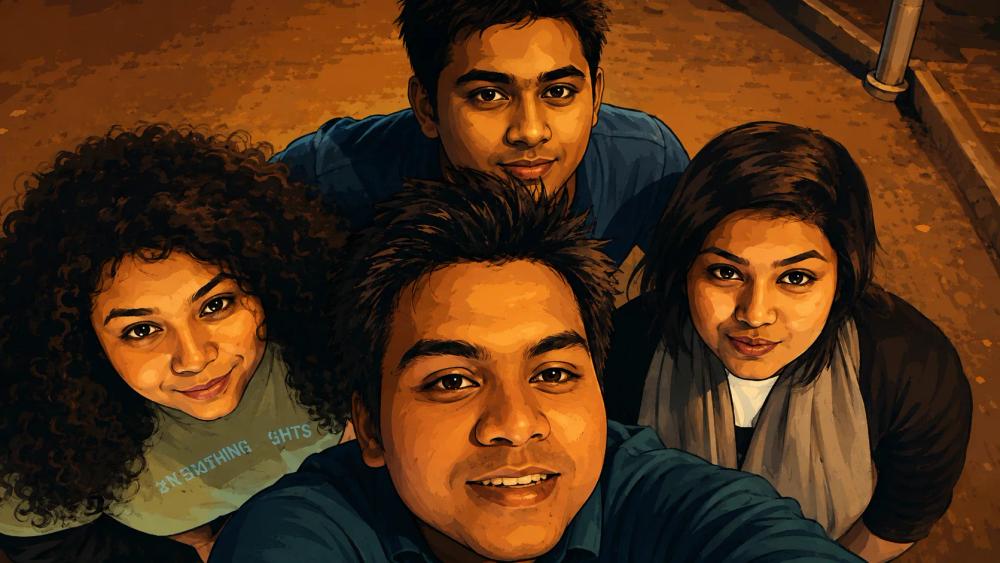
Kolkata still gave us a memorable first evening abroad. It felt familiar and different at the same time. People spoke Bangla, but the yellow taxis, old buildings, trams, and streets gave the city a character I had never experienced before.
Inside IIT Kanpur
Early the next morning, Narjis and I flew from Kolkata to Lucknow. From there, we travelled for several hours by road to IIT Kanpur.
Nothing had prepared me for the campus. It felt like an entire city, with enormous fields, wooded areas, drones flying overhead, engineering projects everywhere, and even an aircraft built by students.
Before that trip, I had mostly seen Indian universities in films. Suddenly, I was inside one, although it looked nothing like Student of the Year.
The scale of the event was unlike anything I had attended. Posters and banners about robotics covered the campus. International scientists, performers, students, and teams filled the opening ceremony. Everywhere I looked, something was being built, demonstrated, or discussed.
What I remember most clearly, however, is the hospitality. IIT Kanpur assigned volunteers to support us as international guests. They helped with transport, showed us around the campus, answered every question, and made sure we never felt lost despite the rushed travel and visa confusion.
The organizers had already helped find flights when Narjis and I thought the trip was over. Once we arrived, the same care continued. For students travelling abroad for the first time, that support mattered more than they probably realized.
Like most robotics events, the night before the showcase was spent repairing and testing the robot instead of sleeping. The following day, WALL-E worked, greeted visitors, and represented our university exactly as we had hoped.
Leaving early
Soon afterward, I packed my bags. My transit visa had won. I left before the closing ceremony, the celebrations, and the sightseeing the others would enjoy.
After I returned to Bangladesh, an immigration police officer told me I could have stayed a few more days and paid a fine because India was a neighbouring country. That may have been true in my case, but overstaying would still have left a record in my passport. I would not recommend testing it.
At the time, I felt unlucky. Looking back, the early departure is not what I remember most.
I remember standing inside IIT Kanpur, representing BRAC University with a robot our friends had rebuilt together. I remember the volunteers and organizers who rescued a nearly impossible trip, welcomed us warmly, and treated us as valued guests from the moment we arrived.
For someone who had once believed robotics was too expensive to even begin, that was more than enough.
Thank you, India. Thank you, IIT Kanpur.