By the time we started building Duburi 2, almost everything around us had changed.
This is the last post in my robotics series. The main Duburi story was the first robot and our first trip to Singapore. This one starts after we came home, when we decided to build the next version while university life was already beginning to change around us.
When we came back from Singapore in 2018, people congratulated us. We were happy too. BRACU Duburi had performed better than we expected at SAUVC, but the more useful thing was what we had learned by being there. We had spent days looking at other teams' thrusters, connectors, enclosures, sensors, and mechanical designs. We came home knowing much more clearly what we wanted to build next.
We finally knew what we were building
That did not mean we suddenly knew how to build a perfect AUV. We simply knew far more than before, including which components existed and which problems other teams had already solved properly. Many of those components were still difficult to get in Bangladesh.
Duburi 1 had worked, but its body was not particularly hydrodynamic. For Duburi 2 we wanted something smaller, more compact, and much easier to move through water.
We were still not sure when university funding would arrive. That was normal for us. The useful difference was that we did not have to start completely empty-handed. In Singapore, Tawfiq Taher had given us two Blue Robotics thrusters. Even hardware intended for hobbyists and student researchers was expensive for us then, so those two thrusters felt like a serious starting point.
By mid-2018, we also knew fabrication shops around Old Dhaka from years of building different robots. A lot of our robotics work had always happened outside the university anyway, including at the bachelor apartment we jokingly called our robotics incubator mess.
The design process itself had changed. With Duburi 1, we often built something, discovered why it was wrong, modified it, and repeated the process. This time Sakib, Arko, and I spent much more time designing the structure first. Sakib particularly enjoyed CAD work, and I learned enough to join in. We used Fusion 360.
Blue Robotics published precise dimensions for its components, so we did not need the physical thrusters in our hands before designing around them. We modeled the structure, printed full-size drawings, took those drawings to workshops, and asked them to cut the aluminium pieces and drill the holes according to the design.
It was heavier than I would have liked, but much more compact and precise than the first Duburi. We also made a new acrylic enclosure. By then waterproofing no longer felt like complete black magic. We had tried enough terrible adhesives to know that epoxy resin was usually the thing we trusted most.
Near the end of 2018, university funding finally came through. We ordered six Blue Robotics thrusters, underwater pressure sensors, and a few other components that were particularly difficult to replace locally. Anything we could reasonably source or fabricate in Bangladesh, we still tried to keep local.
By the time the shipment arrived, the structure was already waiting for it.
Everything was happening at once
There was one major difference between building the two versions: this time the three of us did not have unlimited student time anymore.
Sakib and I were also finishing our final courses and thesis. Our thesis stayed close to underwater robotics: we built a small watertight device that could sink, collect water-quality measurements, release a weight at a target depth, and float back to the surface.
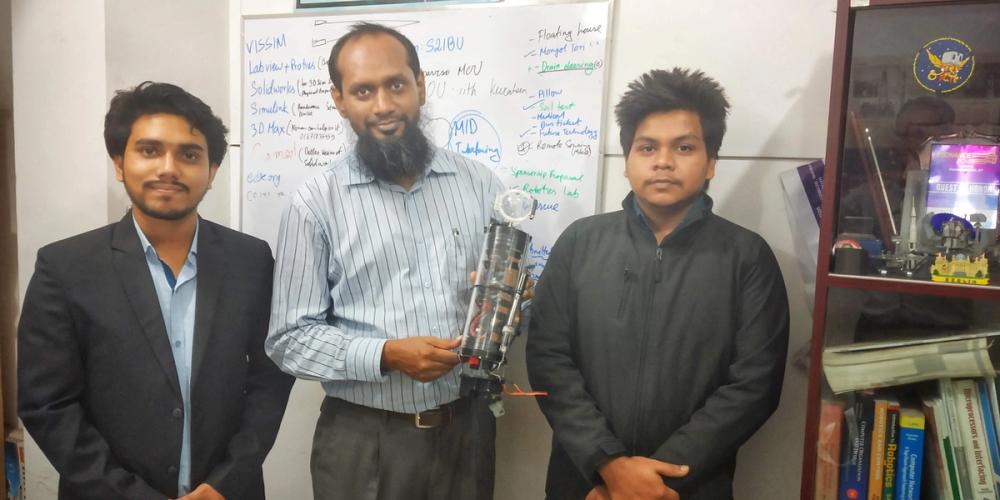
At the same time, we had our courses, the robotics club, Duburi, and paid robotics work outside the university. I was also preparing for the career I expected to have after graduation: software engineering.
Moving from robotics into software was not a painful decision for me. I had always loved programming, and by then I was becoming interested in the larger systems behind the software I used, so software engineering felt like another direction I genuinely wanted to explore.
Sakib and I graduated in December. I started working as a software engineer almost immediately, and Sakib later moved into embedded systems. Arko was carrying most of Duburi's day-to-day work. I remained the team lead on paper and kept coming back for mission logic, machine vision, testing, and whatever else needed me, but in practice Arko and Sakib were increasingly running the preparation.
After office, I would often go straight back to the team. This time we even had funding to rent larger swimming pools around Dhaka for testing. One of the pools I remember was in Mirpur.
Duburi 2 was fast. Much faster than the first robot. It could maneuver properly, and the machine-vision system was working well enough that we deliberately ran the robot slower than its mechanical limit so the vision pipeline had enough time to process what it was seeing.
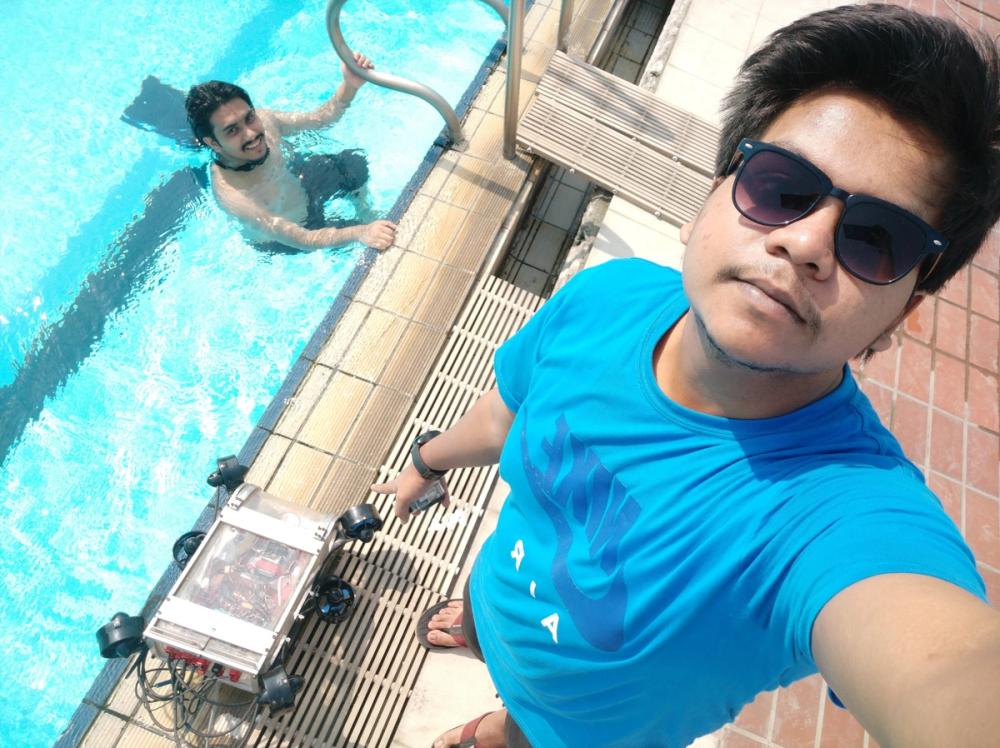
For once, we were going to Singapore feeling confident.
Two days before Singapore, we lost the depth sensor
Only a couple of days before SAUVC, the remaining proper depth sensor was accidentally damaged while a younger team member was interfacing it.
I am deliberately not naming him here. He was a fresher, enthusiastic, technically promising, and already working with me on AI and image processing. One sensor had been damaged earlier, so this was the last one we had.
I did not complain to Dr. Khalilur Rahman, our faculty advisor, or make an issue of who had broken it. Sakib and Arko agreed. We were graduating. The younger students were the people who would have to continue the team after us. Making one of them look irresponsible in front of everyone would have protected my reputation and achieved very little else.
Besides, we had an old solution: the balloon depth sensor, an improvised pressure-sensing setup built around a balloon that let us estimate how deep the robot was.
The same kind of improvised pressure-sensing mechanism that had helped the first Duburi survive before we could afford proper underwater sensors was suddenly back inside a robot that otherwise looked nothing like its predecessor.
Testing still went well enough that we left for Singapore believing we were ready.
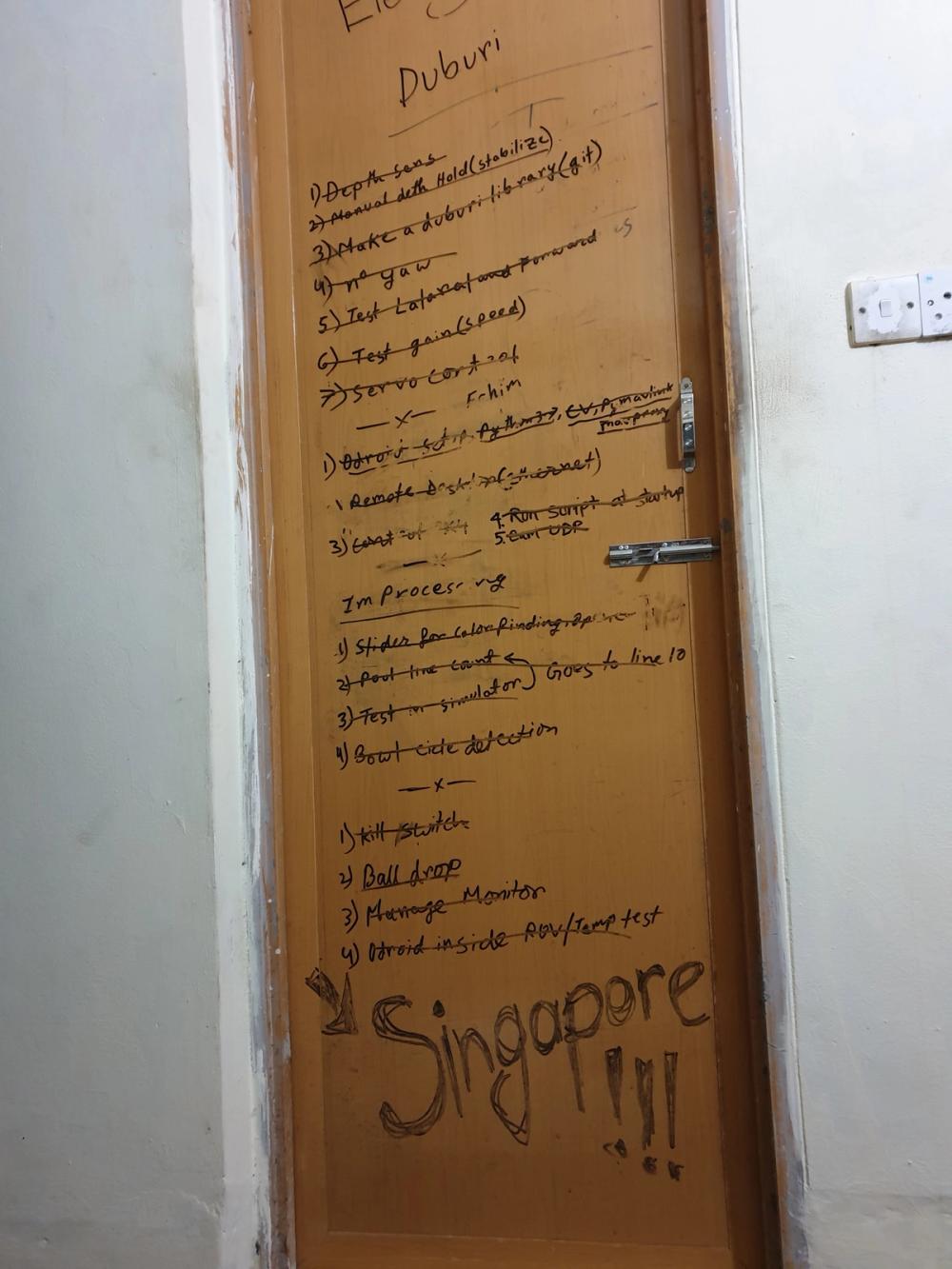
Back to Singapore
Our visas arrived very late, so instead of reaching Singapore with a comfortable day before testing, we landed on the testing day and went from the airport to the venue with the robot.
There were more of us this time, roughly eight people travelling with the team. The SAUVC organizers remembered Duburi and seemed genuinely happy to see how much the robot had changed.
We tested it again and again. The thrusters worked. The vision worked. The robot moved well.
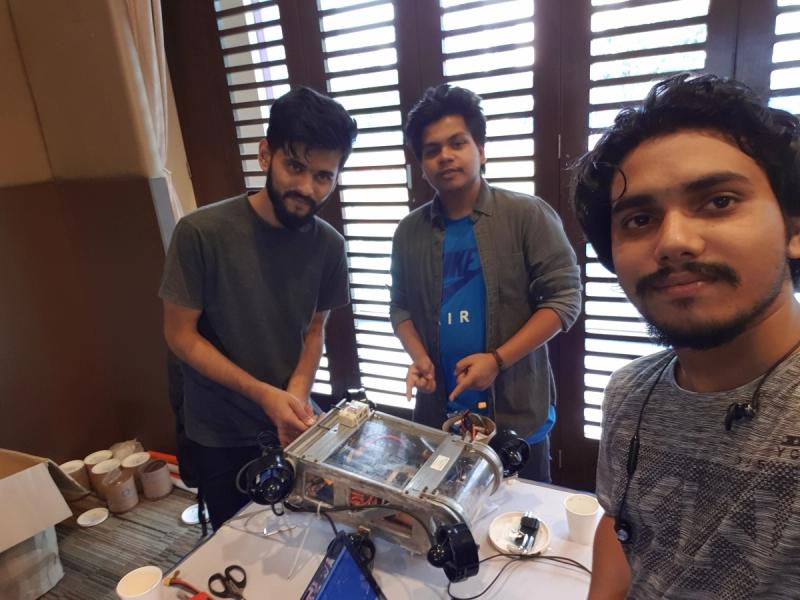
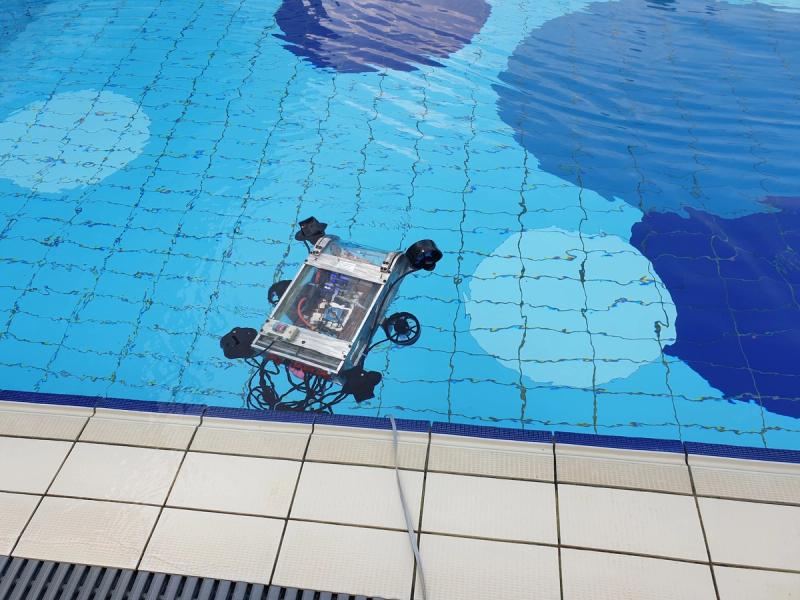
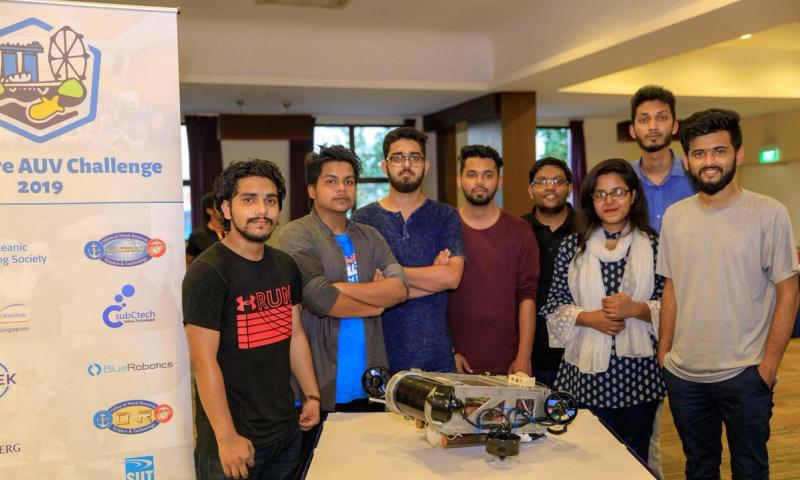
The qualification task was harder than the straight 50 metres we had faced the previous year. This time Duburi first needed to descend to its operating depth, then navigate through a gate.
Before our first run, I remember telling Arko that qualification should be easy. We should already be thinking about the next day, the mission strategy, and how we could get into the top three.
Then we started Duburi.
It went down.
And kept going down.
It reached the bottom of the pool.
We just stared at it. That was not supposed to happen.
A diver pressed the kill switch and brought the robot back. We checked what we could and tried again.
Same thing.
Even the improved enclosure still took four or five minutes to open properly. Under normal conditions that was fine. During qualification, with everyone nervous and the clock disappearing, four or five minutes was enormous.
Eventually we had about five minutes left. There was no realistic way to open the robot, diagnose everything, close and seal it again, and get another useful run.
We did not qualify.
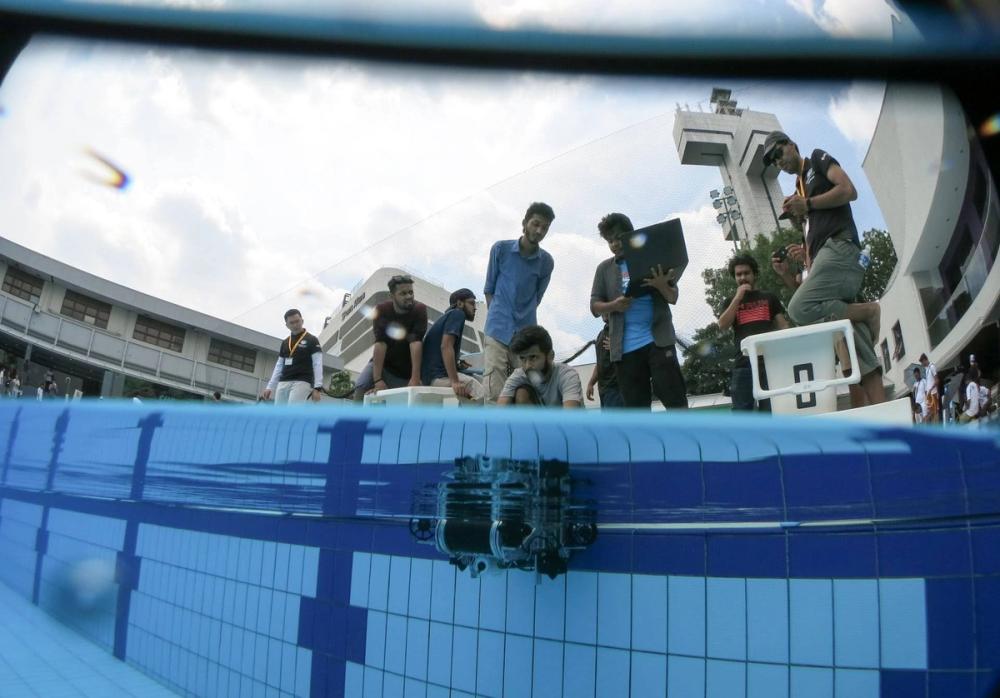
Later, when we could finally inspect the system properly, we found condensation inside the improvised depth-sensor mechanism. The pressure reading was wrong, and Duburi had kept commanding itself downward because it did not understand where it actually was.
The first Duburi had been held together by improvised parts and somehow reached the final. Duburi 2 was faster, cleaner, more precise, and built with proper underwater hardware. It did not get through qualification.
Nobody around me needed to blame me. I was already doing that myself. Technically I was still the team lead. I knew why the proper sensor was gone. I had agreed to the fallback. Whatever the circumstances were, I was responsible for the robot we put into the pool.
Standing there after qualification, I did not suddenly regret protecting the fresher who had damaged the sensor. I regretted that our fallback had failed, and as team lead I had to own the choice to use it. Even after seeing the result, I still would not have wanted to put a fresher's name in front of everyone just to make my own responsibility look smaller.
After Singapore
Coming home from Singapore in 2019 felt like the end of my active Duburi years, but not like the end of the team.
I lived directly behind BRAC University's Mohakhali campus. Arko was leading Duburi, Sakib had started working, and I was working full-time too. Yet after office we would still end up around the university, at the club, or at the tea stalls in front of it. Bottola was one of the places where we could almost always find somebody we knew. For most of 2019, I never really felt that I had graduated.
Then COVID disrupted everything in 2020. During that period, Sakib, Adil Hossain, and I even built a small CPAP-related proof of concept at home. Mostly, though, the old rhythm around the university disappeared.
Almost two years passed. The gap was long enough that many of the students who should naturally have inherited Duburi had themselves graduated or moved on.
Eventually a younger group wanted to bring it back. Among them were Fahim Abrar, Nayem Hossain Saikat, S. M. Navin Nayer Anik, Mishu, and others.
They were not sure whether Dr. Khalil would believe the team could restart after such a long gap. Fahim and Saikat came with me when I spoke to him about it.
His concern was reasonable. Two batches had effectively passed through the university during the interruption, and much of Duburi's knowledge had always lived outside formal university workshops.
I told him there were still people.
One thing I had done throughout my university projects was avoid building teams from only the batch immediately below mine. If a fresher was curious, I wanted them around. There had always been younger students cleaning the test tank, carrying equipment, attending workshops, asking questions, or taking on small pieces of work long before they were senior enough to lead anything.
COVID had broken the visible chain, but it had not erased everyone in it.
Dr. Khalil agreed to give them a chance. Arko and I joined as co-advisors while he remained the faculty advisor. I helped when I could, and Sakib still helped from the side, but Arko became far more involved with the new team than I did.
Saikat turned out to be the kind of stubborn leader I recognized immediately.
They wanted RoboSub in the United States. I suggested SAUVC first. RoboSub was harder, and I thought one familiar competition before that jump would make sense.
Saikat wanted RoboSub.
I could hardly complain about someone being stubborn about a robotics competition.
They went in 2022. I tried not to add to the pressure from people saying they might win. For a first trip, I thought the important thing was seeing RoboSub properly, understanding the environment, and coming home knowing what they needed to improve. They won the Best Rookie Team award.
Then they kept working.
In 2023, BRACU Duburi returned to RoboSub and finished second overall among 34 international teams. They also received the Ingenuity Special Award.
The students who built that robot, and people like Arko who stayed closely involved with them, earned that result. Saikat has even asked about continuing this series someday. I hope he does.
A few years later
Arko, Saikat, Mishu, and others from that extended group eventually built DuboTech, a Bangladeshi deep-tech company working on underwater robotics and autonomous systems.
I do not want to turn this into their company history. They have their own story. The part that matters to mine is simpler: something that started with students building an underwater robot eventually became something people were trying to build a real business around.
In 2024, I moved to Dubai for work. A few months later, DuboTech came to Dubai for GITEX Global. I had been missing that group badly. Most of DuboTech's technical people had come through Duburi, and by then calling them my juniors felt wrong. They were my friends.
My company had a rule that annual leave became available only after six months of probation. Somehow, almost perfectly, their Dubai trip arrived right as those six months ended. I took nearly a week off and spent it with them, taking them around Dubai and getting back a small piece of the life I had left in Dhaka.
That was one of my favourite weeks after moving here.
Our paths kept separating after university. Sakib stayed close to underwater robotics, received an Erasmus scholarship, and is now doing a PhD in Germany. I moved into software engineering and eventually to Dubai. Arko stayed in Bangladesh and remained closest to the thread that began with Duburi.
The last Duburi I actively helped build did worse than the first one.
But Duburi itself did not end with us. The people who came after us reached RoboSub, finished second, and some of them turned what began as a university project into a company.
And that is where both my university life and my active years in robotics came to an end.