In the earlier parts of this series, I wrote about how I entered robotics, travelled to India with WALL-E, taught workshops, and explored the Robotics Club of BRAC University, usually called ROBU.
This story starts much earlier, near the beginning of my robotics life, but it follows me for years. It is about the competitions I entered, the many ways I failed, and why losing became harder after people started expecting me to know what I was doing.
The first team that would not let me touch the robot
Before I became active in ROBU, I saw Sakib and one of his friends preparing for line-follower robotics competitions. A line follower is a small wheeled robot that follows a marked path through curves, crossings, and junctions as quickly as possible.
They invited me to join their next competition. I contributed money for components, but because I was new and the hardware was expensive, the others were understandably worried that I might connect something incorrectly and burn it. I was barely allowed to touch the robot.
The team failed again. Even so, building the robot was fun, and Sakib later became one of my closest friends. We would spend most of our university years building, teaching, and failing together.
Building one myself
After Hirok's free robotics workshop, I told him that I wanted to try another line-follower competition. Hirok offered the components and registration fee, but he gave me one condition: he would advise me, while I would build and interface everything myself.
I went to Hirok's home and started connecting motors, sensors, a motor driver, and an Arduino Nano. The Nano was compact, and because Hirok ran a robotics-components business that I was helping with, we also wanted the robot to look slightly more polished.
Hirok first gave me a QTR reflectance-sensor array, one of the popular choices for line followers at the time. It could read the contrast between the dark line and the lighter track very accurately, but it was sensitive to height, calibration, and how the code interpreted its readings. With very little time left, I struggled to make it work reliably.
He then gave me an infrared sensor array he had designed for his components business. His goal was to create something simpler and more affordable for students. It was easier for me to read each sensor directly, so I switched to it.
The next problem was the algorithm. I tried tutorials and simple conditions, but the robot either reacted too slowly or turned too aggressively. Then I found PID control.
PID continuously adjusted the robot based on how far it had moved from the line. I did not understand the mathematics well enough then. I only knew that changing three values could make the robot smoother, worse, or completely uncontrollable.
I stayed awake through the night changing values, lifting the robot back onto the track, and watching it make the same wrong turn in slightly different ways. At some point Hirok went to sleep and told me to keep trying. I kept hearing the motors start, the wheels scrape across the floor, and the robot leave the line again.
The competition started at nine in the morning. At around seven, one combination finally worked. After a night of random numbers and failed turns, the robot suddenly followed the line smoothly enough that I woke Hirok and told him we had to leave.
The event was at the Military Institute of Science and Technology, usually called MIST, in Dhaka. It was the first robotics competition where I arrived carrying a robot I had built myself.
For the first few seconds, it ran properly. I watched it follow the line and briefly felt that the sleepless night had been worth it. Then it reached a bump in the track, failed to cross it, and was disqualified.
I was still happy. At that point, losing felt private. I was new, nobody expected me to know what I was doing, and the robot had at least moved, read the line, and competed. Hirok treated it as progress rather than a disaster. We also discovered an intermittent power problem: the controller sometimes shut down when the sensor array and motors drew too much current.
Losing again, but finding a product
For the next line-follower robotics competition at North South University, I was better prepared. I understood PID more clearly, and we made the robot smaller and lighter so it could turn more sharply and use less power.
Narjis funded the registration and arranged to pick us up in the morning. By then, Hirok, Sakib, Narjis, and I had become a close group, and she regularly helped turn our plans into actual trips.
We failed again. The sensor array still created power problems, and the Arduino could shut down at the worst possible moment.
But this failure gave us something useful. We were testing Hirok's sensor design in real competitions before selling it to students. Sakib gradually took over the hardware, corrected the design, and produced an array that worked reliably.
The commercial QTR arrays were excellent but expensive. Our version became much cheaper, easier for beginners to interface, and reliable enough for our competition workshops and Hirok's business. Other robotics-component sellers later bought it in bulk.
We had lost another competition, but we had also found a hardware problem before customers did. Failure was becoming part of our product testing.
When losing stopped feeling private
By then, I was teaching robotics workshops through the Robotics Club of BRAC University. Juniors knew me, students came to me with problems, and I was helping others prepare for the same competitions I kept losing.
That created a fear I did not immediately recognize. The registration fees and components were no longer the main issue. Hirok and Narjis often helped with those costs. What frightened me was standing beside the track while students who knew me as a teacher watched my robot fail.
It was not a useful fear. Helping another team felt safer because their result did not feel like a public judgment of my own ability. I became more comfortable preparing students for line-follower competitions than standing beside the track with my own robot.
The fighter bot we thought was unbeatable
We did try a different kind of robotics competition at another MIST event: fighter bots.
These were not humanoid robots throwing punches. They were heavy, remotely controlled metal machines designed to push, strike, lift, or damage an opponent inside an arena. Depending on the rules, they could weigh around ten kilograms or more, and every round could leave damage that was difficult to repair on the spot.
We asked an experienced alumnus, Hridoy bhai, to help us. We spent about a week building the robot and testing its movement and weapon against anything available. Because we never tested it against another fighter bot, we naturally concluded that nobody could beat it.
The most difficult part was controlling the robot under pressure. Watching two heavy machines collide creates a surprising amount of stress, even when nobody is physically inside them. Hridoy bhai had the experience and composure we lacked, so we found a way for him to join the team and operate it. That made the whole experience more enjoyable. We trusted him, learned from him, and could focus on the excitement of seeing something we had built survive inside the arena.
We passed the first round, then another. Each victory also damaged the robot. Bent metal, loose parts, and worn mechanisms accumulated, and there was little time or equipment to rebuild a steel body between matches.
We came close to the end without becoming champion, but I never thought of that event as a failure. It was one of the most exciting competitions I attended. Hridoy bhai helped us take a robot we had built in about a week through several intense rounds, and every round gave us another story to remember. The only difficult part was the cost: even a successful fighter bot often went home with bent metal and broken parts.
After that, I spent more time on robotics projects, workshops, and paid work for students and research teams. I travelled abroad for a few competitions, but locally I stayed away from the line-follower events that had started all of this.
One last competition
That continued until 2018.
By then, many of the students around me at the Robotics Club of BRAC University had attended our workshops. Some were also working with us on BRACU Duburi, an autonomous underwater robot and the first project of its kind in Bangladesh. I had helped build and lead that team, but that story belongs later in this series.
Those students encouraged me to enter a line-follower robotics competition at Dhaka University of Engineering and Technology, usually called DUET.
For them, the plan was simple. We would build the robot, win the competition, and spend the prize money on a party.
Their confidence was difficult to resist. They did not carry the memories of my earlier competition failures. They knew me as the person who had taught them robotics and worked beside them, and they were completely certain we could win. After years of avoiding local line-follower competitions, I agreed to try once more.
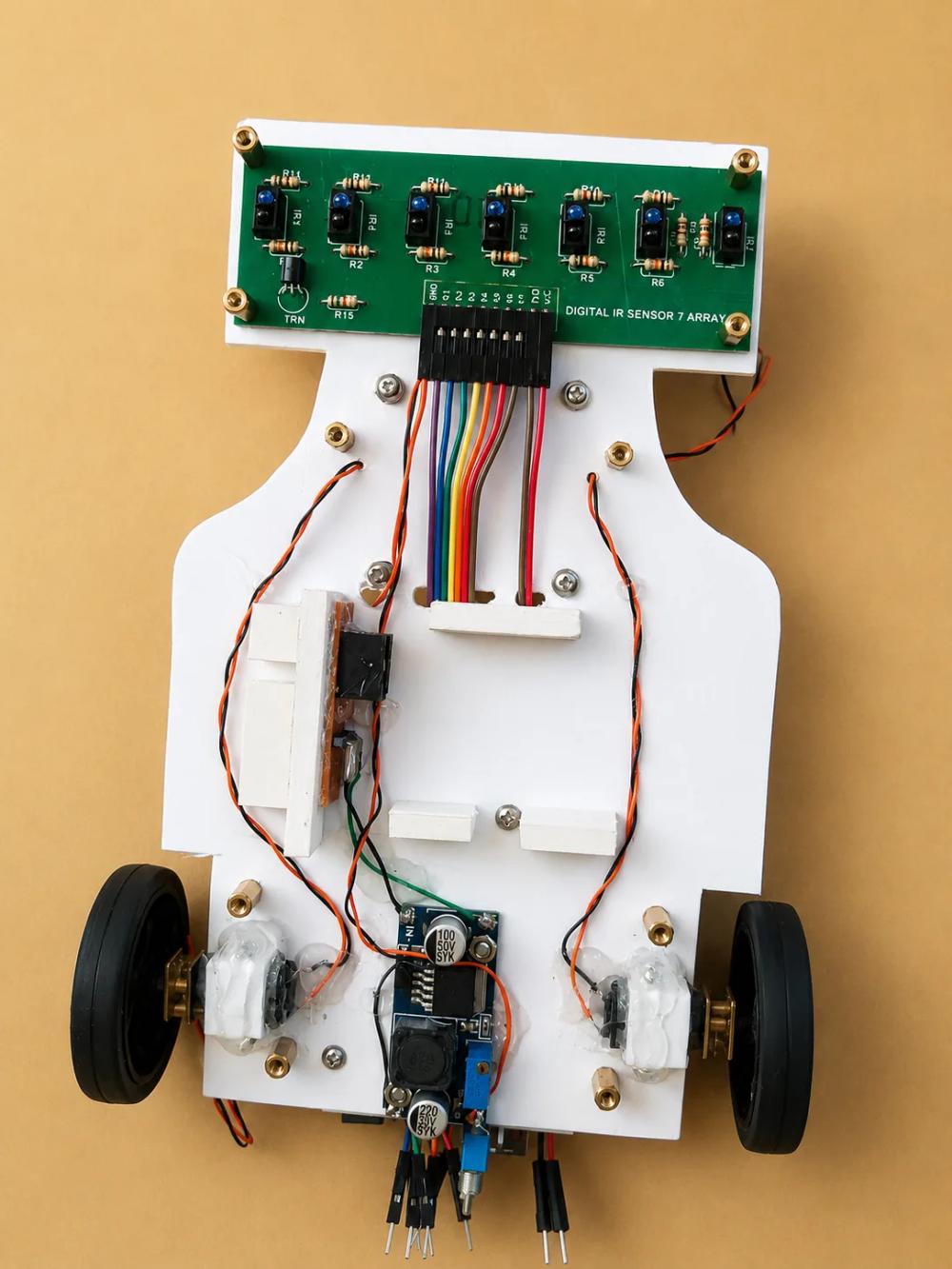
This time, the result was different.
I will tell that story in the next part.