We had somehow made it to Singapore with BRACU Duburi, an autonomous underwater vehicle (AUV) we had built in Bangladesh from improvised motors, fan blades, acrylic, cheap sensors, and a lot of stubbornness. The first thing the competition taught us was that getting there had been the easy part.
We arrived at the Singapore AUV Challenge 2018 as an underdog team from Bangladesh with a homemade autonomous underwater vehicle and no real idea how it would compare with the machines around us. From there, the trip became a sequence of small decisions under pressure: watching stronger teams, taking risks, fixing things at the worst possible time, and trying to keep Duburi alive long enough to find out what it could actually do.
There were four students travelling with Duburi: me, Arko, Sakib, and Ananto. Dr. Khalilur Rahman came with us. In the previous part, we had taken the robot to the airport without ever completing a full autonomous run from start to finish. Now it was on a plane to Singapore.
When we landed at Changi, Dr. Khalil was the only one among us who already knew the city. During the taxi ride he watched the four of us staring outside and laughed. "Welcome to the first world country."
We stayed around Paya Lebar, at a hotel I remember being called something like Aqueen. We had wanted somewhere with a pool so we could test Duburi, but that was too expensive. The trip already cost far more than the robot itself.
That evening we heard engines from the road and went outside. Then a Lamborghini passed us.
There was a traffic light nearby, so expensive cars kept stopping in front of us. We stood there staring at them like children.
At one point I was standing very close to a parked car while watching the road. Arko looked at me and said, "Adnan bhai, you have to sell your kidney."
I asked why. He pointed at the car and told me it was a Porsche. I think he thought I was about to lean on it, so I moved a little farther away.
My first international trip, to India, had sometimes felt like walking into a Bollywood movie. Singapore felt different. The polished streets, the cars, the skyline, everything around us had a more cinematic, expensive feel to it. Standing there that evening, the comparison finally came to me: it felt a little like we had walked into Hollywood.
The Most Homemade Robot in the Room
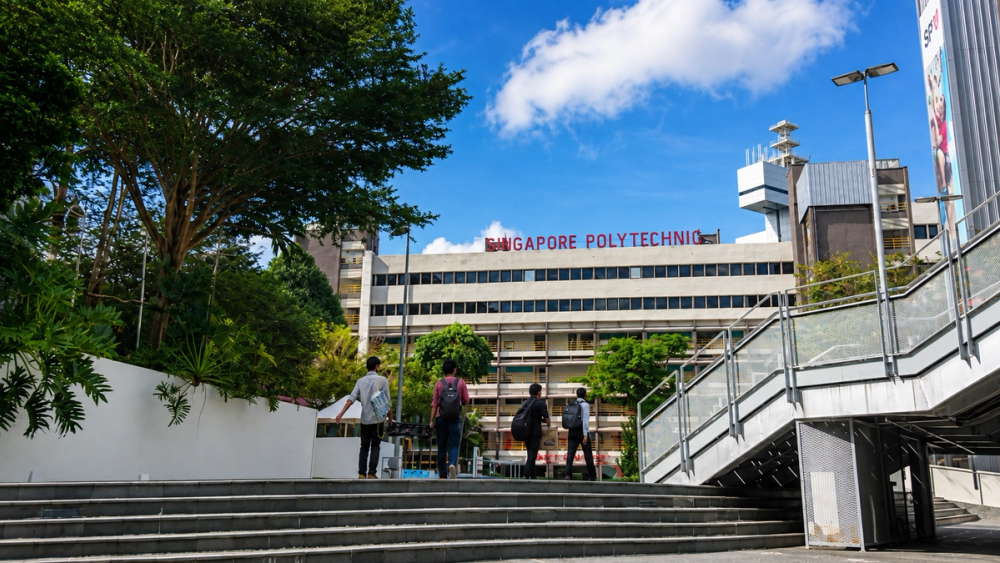
The next morning we went to Singapore Polytechnic, the competition venue. One taxi could take the four students and the robot, but there was barely any space left. Dr. Khalil decided he would take the MRT alone. I asked him to let me go by MRT instead, or to take another taxi. He refused. We were new to the city, he knew the route, and he did not want to spend university money on a second taxi.
That was the second time I noticed how carefully Dr. Khalil treated the university's money. Before the trip he had told us to keep every food and drink receipt, even outside competition hours. I assumed it was mainly about claiming back taxes when we left Singapore. At the end of the trip, he collected them and reimbursed our reasonable expenses through the university. He was not trying to make us spend our own money. He simply did not want us spending carelessly because someone else was paying. That distinction stayed with me.
We reached the venue very early. Most teams had not arrived yet, so we started unpacking Duburi while the room slowly filled.
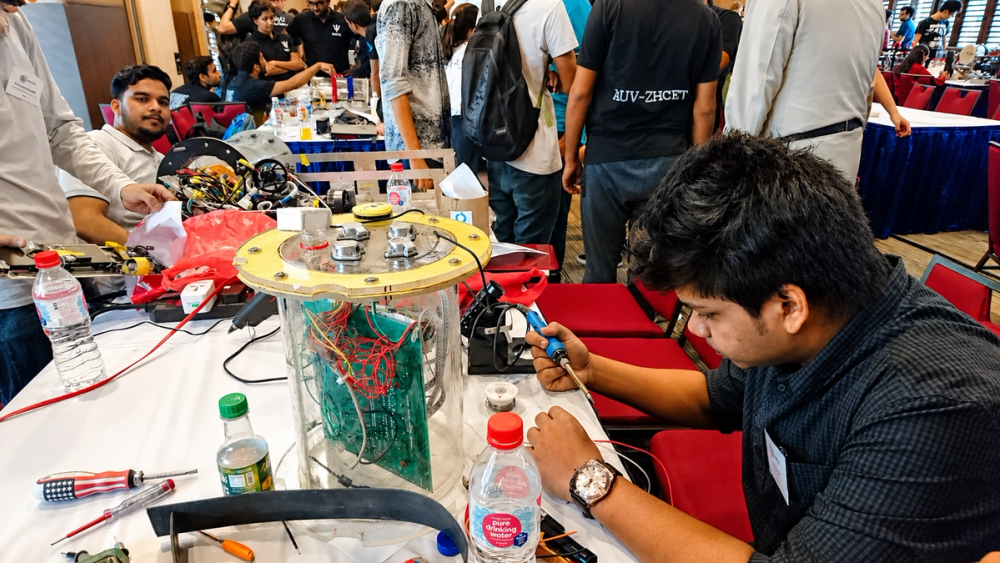
Then the robots started appearing.
Proper thrusters. Clean enclosures. Beautiful connectors. Custom boards. Frames that looked machined rather than improvised. Some robots were so large that teams brought them in on trolleys. Teams like Hornet from NUS, along with strong Russian and Chinese teams, had machines that looked like the kind of AUVs we had spent months seeing only on YouTube and Google.
A proper underwater connector sounds boring until you have spent months trying to waterproof cables with whatever you can find. The same was true for the thrusters. We had built ours from ordinary motors, fabricated housings, and fan blades. Here, teams were unpacking hardware we had mostly seen on YouTube and Google.
We were supposed to be assembling Duburi, but every few minutes another robot arrived and distracted us. One of us would stay at the table while the others walked around. If someone found an interesting component, the rest got called over.
That was how much of the first morning went: assemble a little, wander off, stare at somebody else's engineering, come back, repeat.
We also met Tawfiq Taher, a Bangladeshi volunteering at SAUVC. He was happy to see a Bangladeshi team there, and we were equally happy to find someone from home. Once he saw Duburi and understood how much of it had been built from improvised parts, he became even more interested.
The event itself felt surprisingly informal. There was no long ceremony. Ahmed had the microphone, introducing teams, commenting on robots, and making jokes as things happened. It felt loose without feeling disorganized.
At some point a group of professors and technical visitors started going from table to table. We initially thought they were judges, so we prepared ourselves to present properly.
When they reached Duburi, I started explaining. Then someone asked something Arko knew better, so he joined. Someone else asked about electronics, and Sakib joined. Ananto and Dr. Khalil were part of the conversation too. Very quickly it stopped feeling like a presentation. It became a group of people standing around Duburi, asking how different parts worked.
I did not need to explain every strange decision we had made because those details belong to the previous part of this story. But once they understood that our enclosure, connectors, depth sensing, and much of the mechanical structure had been built through improvisation, more people started gathering around.
They were curious. We were excited. At the same time, somewhere in the back of my head was one uncomfortable thought: everyone is very impressed by a robot that barely works.
It Worked. That Was the Problem.
After lunch, the pools opened for testing. We could not casually use the main competition pool, so we took Duburi to one of the smaller ones.
Some of the professors and technical visitors who had been asking about our strange robot came to watch. We lowered Duburi into the water and started it.
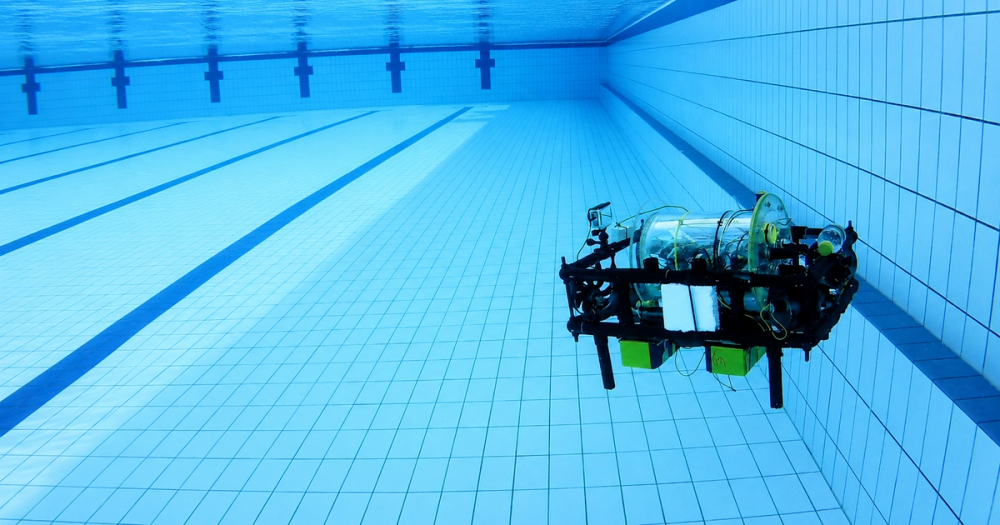
Duburi moved.
We clapped.
We ran it again. Then again. Four or five times in total, partly because we needed to test it and partly because we still could not believe the robot we had carried from Dhaka was actually working in Singapore.
The celebration lasted until we looked around.
Then another robot entered the water. It moved like a rocket compared with ours. Another did the same. Duburi suddenly looked painfully slow.
At the Singapore AUV Challenge (SAUVC), qualification sounded simple on paper: travel 50 metres straight. Only 15 teams would advance. Before Singapore, we had thought 50 metres sounded easy. Duburi could go straight. We had spent a lot of time making sure of that.
Now we understood the real problem. Duburi might complete the distance, but it would take far too long. Even if it worked perfectly, we expected to be at or near the bottom on time.
There was one reason Duburi could do things that its individual components did not suggest it should be able to do. None of our mechanical, electronics, or software systems were exceptional on their own. The strength was that they worked together. If the mechanics introduced an error, software could often compensate. If one electronic measurement was unreliable, another part of the system could sometimes cover for it. We had built a complete package out of imperfect parts.
That integration was enough to keep Duburi moving straight. It was not enough to make it fast.
We stopped testing after a few runs. Our motors and improvised hardware degraded quickly in chlorinated water, and we did not want to destroy a robot that was finally working. The thinking was simple: it works today. Inshallah, it will work tomorrow.
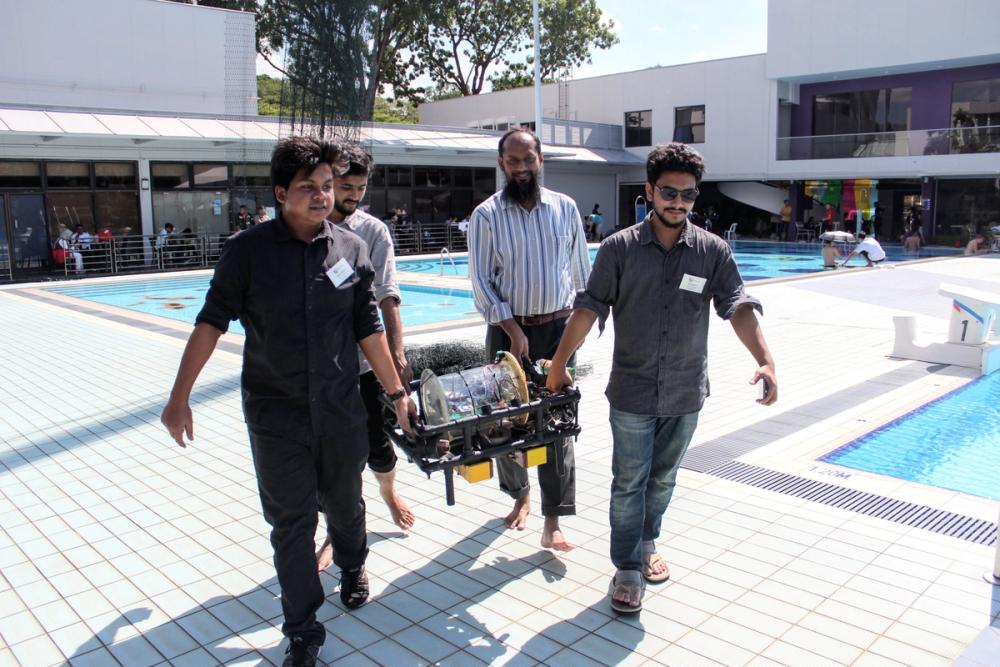
The Robot Worked, So We Wanted to Change It
Our qualification slot the next morning was early. Once we knew that, me, Arko, and Sakib started discussing the speed problem seriously. The whole group, including Ananto and Dr. Khalil, joined the discussion.
Arko remembered two spare motors in our bags. We called them drill motors because they were the type used in rechargeable drill machines. They were fast, but we had not used them in Duburi for other reasons. We also had two small boat propellers left from my original RC boat idea.
The idea was to build a booster system: something completely external that we could attach to Duburi just for qualification and use to give the rover an extra push. The implementation was exactly the kind of idea that had created Duburi in the first place. Put the two motors outside the robot. Add the spare propellers. Put a battery and a microcontroller in some kind of airtight container. Make the extra motors turn on after Duburi had already descended and started moving. Attach the whole thing externally so we could remove it if it failed.
Dr. Khalil immediately said no.
His argument was reasonable. Duburi worked. We had brought it all the way to Singapore. If we failed with the robot we had, that was still respectable. He had also seen this pattern before through BRAC University robotics teams. The club had already produced projects such as Chandrobot, Mongoltori, quadcopters, and other robots that went to different competitions. He had watched teams behind those projects make last-minute changes, break working systems, and lose everything at exactly the wrong moment.
I remember telling him, "Sir, maybe that is why they went so far."
Those teams had achieved a lot too. From my point of view, maybe they had gone that far partly because they were crazy enough to keep taking those risks. The same behavior that could destroy something at the last moment might also have been part of what pushed them further than most people would go.
For us, doing nothing did not feel safe. We already knew what would happen if we left Duburi unchanged. It would move. It might even complete 50 metres. It would simply take too long. Preserving a working robot only to accept the result in advance did not feel useful.
Dr. Khalil knew us well enough to understand this. He especially knew me. I was usually the person between him and the rest of the team, which also meant I was usually the person arguing with him. He knew that telling me no did not guarantee I would listen.
So he did something smarter. He did not let us take Duburi back to the hotel.
Then, instead of taking us straight back, he took us to Marina Bay Sands.
It was beautiful. We saw the area, the lights, and the water show. But me, Arko, and Sakib were barely present mentally. We were looking at Marina Bay and thinking about drill motors.
Looking back, I think Dr. Khalil knew exactly what he was doing. He kept us outside until late enough that we would have very little time to attempt anything.
Wait Until Dr. Khalil Sleeps
At the hotel, Ananto was sharing a room with Dr. Khalil. Me, Arko, and Sakib were in another room.
That room arrangement gave us a plan.
Ananto's job was to tell us when Dr. Khalil went to sleep, and to warn us if he woke up.
Dr. Khalil came to our room and told me specifically that I needed to sleep. I think he believed that if I went to sleep, the rest of the team would probably stop too. So I went to bed.
Later, Ananto messaged us that he had fallen asleep.
Me and Arko went out.
We needed an airtight box. Not an underwater enclosure, just something sold as a household container that sealed well enough for us to gamble with. We walked around a city we barely knew, looking for a shop we remembered seeing earlier. Eventually we found a container that looked good enough.
Back at the hotel, Sakib had crashed. This was not unusual. During the Duburi build we had already learned that if Sakib stayed awake too late, at some point his body simply shut down. We also needed him functional in the morning.
So me and Arko started assembling what we could. Two drill motors. Two small propellers. Wires. A microcontroller. A battery. An airtight food container.
The control logic was not sophisticated. Duburi took several seconds to descend. We did not want the boosters running immediately because they would interfere before the robot settled. So the plan was to start Duburi, wait roughly ten seconds, then automatically turn on the extra motors.
No new sensor. No intelligent trigger. Just a memorized delay based on how long we knew our own robot usually took.
During the night, Ananto warned us that Dr. Khalil was coming to check. I got back into bed and pretended to be asleep. Arko stayed awake. I remember hearing Dr. Khalil ask if Adnan was sleeping. Arko said yes.
He left. We started working again.
By early morning, the parts were ready enough to pack. When Dr. Khalil came back again, I acted like I had just woken up and told him I was hungry and wanted breakfast.
Technically, I had slept. Just not for very long.
Fifty Metres
We reached the venue early for qualification and stood beside the pool watching the teams before us. I was tired enough to feel it in my eyes, but there was no chance I could relax. We had come all this way, and now a 50-metre pool was about to tell us whether the trip ended here.
The first team came to the pool. Their robot looked prepared. Clean build, serious team, nothing about it suggested trouble. Watching them set up, I remember thinking that our little hope of surviving qualification might disappear very quickly.
The robot started moving. For a moment it looked fine. Then it began drifting. It never completed the 50 metres.
We looked at each other. Nobody needed to say much. Maybe this was not going to be only about speed.
Then another team failed. Then another. Some robots could not hold the line. Others developed a problem at exactly the wrong time. Machines that had looked almost untouchable the day before were suddenly sitting still in the water or being retrieved by divers.
Standing there, 50 metres stopped sounding simple. Underwater, a tiny heading error keeps growing. A loose connection ends the run. One bad component can erase months of work in a few seconds. For the first time that morning, I thought Duburi's biggest strength might actually matter: its parts were imperfect, but they knew how to work together.
Our turn came.
Me and Arko put Duburi in the water. Divers were there to monitor the robot and intervene if something went wrong. Sakib was off to one side finishing the booster connection.
Dr. Khalil noticed. Me, Arko, and Sakib were almost always together during important moments, so Sakib sitting in a corner with motors was suspicious. But the qualification clock had already started.
We ran Duburi without the booster.
Duburi went down and aligned itself. I watched the nose settle. Then it started moving.
Ten seconds. Twenty. Fifty. One minute. It kept going straight.
I knew it was slow, but after watching other robots fail, I stopped caring about the clock for a moment. Just keep going. Don't turn. Don't stop.
At around one minute and fifty-two seconds, Duburi crossed the 50-metre line.
Ahmed announced that the Bangladesh team had become the first team that morning to complete the distance.
For a second I think we were processing what had happened. Then we exploded.
Dr. Khalil hugged me. We hugged each other. The most homemade-looking robot in the room had just done the one thing several polished robots before it had failed to do.
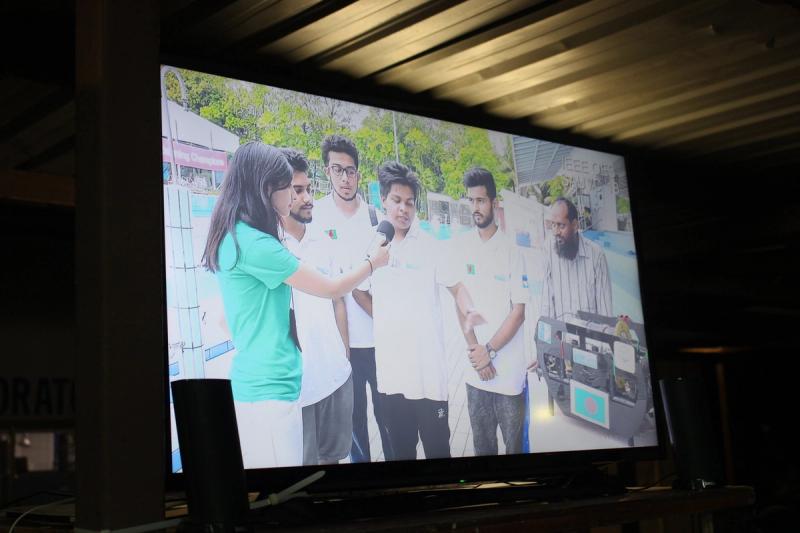
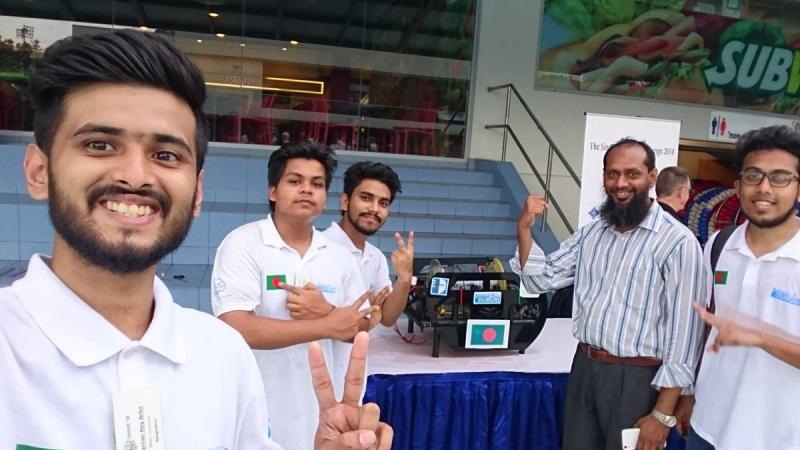
We knew we were still too slow. Completing the distance did not automatically qualify us. So we tried again and improved only a little.
Then Sakib shouted that the booster was ready.
Dr. Khalil looked surprised. I told him we already had a valid run. There was nothing left to lose.
He smiled.
Building the Robot During Qualification
Our qualification clock was still running while we started attaching the new system beside the pool.
We zip-tied two extra thrusters made from the drill motors and small boat propellers onto Duburi. The booster had its own external box with a LiPo battery, microcontroller, and wiring. We intentionally kept everything outside the original robot so that if something went wrong, we could cut it off.
The SAUVC organizers were watching us work against the clock. At one point someone called out, "Guys, you don't have much time." One of us answered, "Just one minute is enough." Ahmed was still joking on the microphone about the Bangladesh team apparently building its robot on the ground during qualification.
By then even Dr. Khalil was helping us tie the booster onto Duburi with zip ties. He had spent the previous night trying to stop us from making this exact modification, but once we were committed and the clock was running, he was helping us get it into the water.
We were also hoping the external battery did not turn the pool into a much more interesting event than anyone had planned.
We started the final run.
Duburi descended. Every one of us was staring at it. My heartbeat felt loud enough that I could hear it. The robot settled, started moving forward, and we waited for the delay we had programmed the night before. Then someone shouted, "It started, it started."
Around ten seconds later, the booster turned on. Duburi jumped forward. I looked at Dr. Khalil and smiled. He smiled back. None of us had ever seen our robot move that fast. To the teams with proper thrusters it probably still looked slow. To us, Duburi had become a rocket.
I walked along the pool beside it, watching the external battery box. Then the inside started turning black. Water was getting in. Sakib called out, "Let's forfeit, let's forfeit." I did not want to stop it. "No, let it run." Duburi kept moving. A little later Sakib gave in too: "Okay, let it go." Somewhere around the middle of the run, the booster itself stopped.
But it had already done enough.
Duburi completed the 50 metres in roughly 50 seconds.
We had cut our time by more than half with two spare drill motors, two old boat propellers, zip ties, a food container, and one night we were explicitly told not to spend modifying the robot.
Then there was nothing left to build. We had to wait.
Team Fifteen
Then we went back to watching the pool.
Because we had run early, almost the entire qualification day was still ahead. The failures before us had introduced a thought none of us had seriously considered before: what if enough teams fail?
We started counting. One team failed. Another completed. Another failed. By lunchtime we were still trying to calculate our chances. Eventually we lost count.
I had barely slept and tried to nap at the venue, but I could not. There was too much happening around us, and too much riding on a number we no longer knew.
By the time qualification ended, we became convinced we were out.
Later in the afternoon, the qualified teams were announced one by one.
Thirteen.
Fourteen.
At that point, I had stopped expecting to hear our name.
Then they announced Duburi as the fifteenth team.
I think we shouted louder for fifteenth place than anyone else had shouted for qualification.
For us, fifteenth meant we were still in the competition.
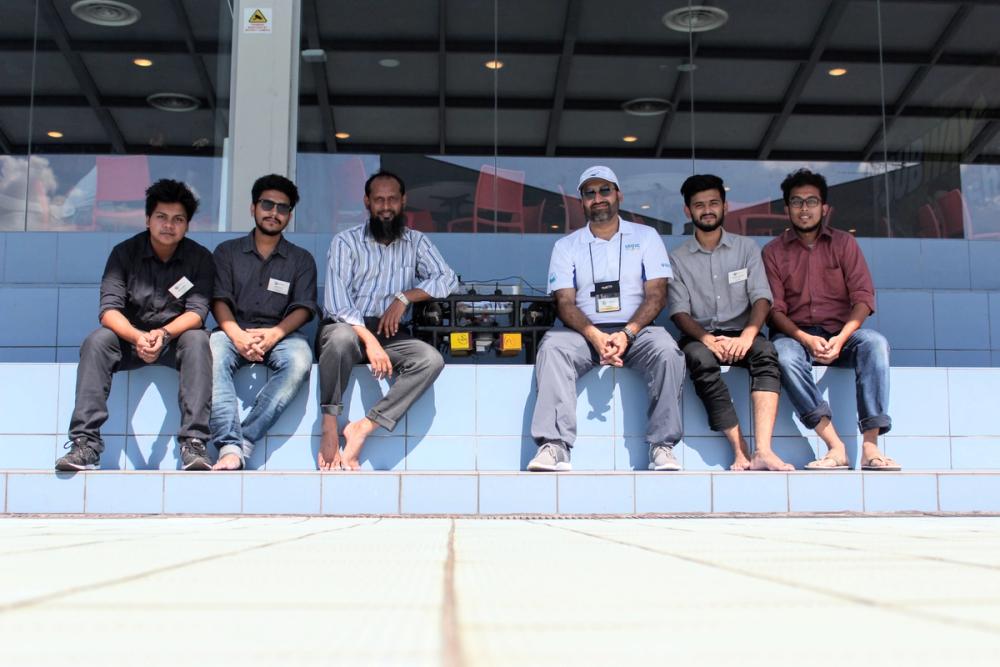
Ananto became especially important around this time. While we were buried in the robot, he handled the outside world. People in Bangladesh already knew we had qualified for Singapore, and now they wanted updates. He wrote Facebook posts, stories, and material that went to news and print media. I remember him spending hours writing while the rest of us were working on Duburi.
Without Ananto, far fewer people back home would have known what was happening. We were not exactly good at stopping in the middle of a competition to write a proper update.
There was one very Bangladeshi piece of bad timing. On the same day, Bangladesh won a cricket match. Naturally, that became the bigger news back home, and our story was buried underneath it. Maybe we would have received a little more attention on another day, but whatever happened, happened.
The Harder Way
Finishing fifteenth meant we would run early in the next stage.
There was a difference between how Dr. Khalil thought about the final and how we did. He wanted us to demonstrate what we had built properly. Follow the tasks, show the technology, and let the result be whatever it was.
We were younger and much more interested in the scoreboard. We knew we were not competing with the strongest teams on hardware. If the rules offered a way to gain points, we wanted those points. We wanted to get as close to the top teams as we could, even if that meant choosing a less elegant strategy.
The funny part is that, when it mattered, we still chose the technically harder option.
Shortly before the competition we had received a Jetson TK1. Think of it as a small computer made by NVIDIA, more powerful than the Raspberry Pi we had been using and much better suited to machine vision. We had the hardware. What we did not have was much time to learn how to use it properly.
In practice, I was still using the Jetson much like a faster Raspberry Pi. The larger housing we had brought to Singapore was partly because it needed more room.
During qualification day we got a short test slot in the main pool. We attached a camera to Duburi and asked a diver to carry the powered-off robot through part of the course so we could record what the camera would actually see.
I also gave the divers an action camera and asked them to record the course and its tasks. That footage came back to the hotel with us so I could test the machine-vision code against the real environment.
That night there was no sightseeing. This time Dr. Khalil knew we genuinely needed to work.
Arko and I stayed awake again. By early morning, the vision pipeline was working well enough. At that point sleeping felt more dangerous than staying awake. If we slept for an hour, we were not confident anyone could wake us.
So we went into the final on a second night without proper sleep.
Almost Through the Gate
We reached the venue early and assembled Duburi for the final.
We had also cleaned up some of the uglier buoyancy hacks from earlier and were using pieces of styrofoam, or what we usually called cork sheet, to balance the robot. Our motors were weak, so buoyancy mattered a lot. If Duburi was too heavy, the vertical motors would struggle. If it was too light, it would keep floating up.
For this run we did not use the improvised qualification booster. Speed was no longer the main objective. We needed to complete tasks.
The first task was a colored gate made from pipes. Our logic was to scan left and right until the camera detected the gate, align with it, and then move forward.
The first attempt failed to detect it.
We brought Duburi back, checked the camera, and tried again.
It failed again.
On the third attempt, the camera finally found the gate.
Duburi aligned and started moving toward it. We had already burned most of our time getting this far, so every second suddenly mattered.
The gate was much closer than the end of the qualification pool, but Duburi was still Duburi. It crawled forward while we watched from the side, trying not to calculate how little time remained.
Then I saw one of the buoyancy pieces come loose.
The robot's body tilted slightly and started sinking.
It was still moving forward. That made it worse. The gate was right there. We could see Duburi approaching it while slowly losing the fight to stay at the correct depth.
For a few seconds I thought it might scrape through anyway. It reached the gate, painfully close to crossing, then settled onto the bottom of the pool.
For a few minutes, that was devastating.
Then we watched the other teams.
Some of them had taken a much simpler approach. Instead of relying on machine vision to find and align with the gate, they aimed the robot carefully and used the kind of straight-running behavior already proven during qualification.
I wished we had done the same.
We had already proven that Duburi could go straight for 50 metres. The deviation was small enough that, with a good initial alignment, we probably had a reasonable chance of crossing the gate without asking the camera to solve the problem for us.
We had spent the night building the more sophisticated solution because we could. In competition, sophisticated and useful are not always the same thing.
Seventh
The strongest teams went much further through the course. A few were clearly operating at another level. For the rest of us, progress through the early tasks separated the rankings.
Duburi ended up in the seventh-place group based on how far it progressed. It was not necessarily a unique seventh place. Other teams could share the same position depending on the scoring.
For a robot that had begun as an RC boat idea and had arrived in Singapore with motors, enclosures, sensors, and waterproofing solutions built from whatever we could afford, seventh was difficult to process.
We were disappointed about the gate because we had been so close. But the disappointment did not last very long. Everywhere we went, people were asking about Duburi. Teams congratulated us. Professors wanted to know how we had built things. The robot that had embarrassed us a little when we first saw everyone else's hardware had become interesting precisely because it looked nothing like theirs.
At one discussion, teams were talking about how expensive underwater robotics was. I remember the judges or senior people pointing toward the Bangladesh team as an example. Their point was that cost was a real constraint, but it was not a complete excuse. We had reverse engineered and improvised almost everything.
That was probably the moment I felt proudest.
What We Took From Singapore
Once our run was over, we stopped thinking only about the current robot. We spent the rest of the event asking other teams what they used.
What connectors were these? Where did they buy their thrusters? How did they seal their enclosures? Which companies made underwater components? We found Blue Robotics and started learning what proper underwater hardware actually looked like. We even asked about discounts because, if we ever built another version, we knew we could not return with the same machine.
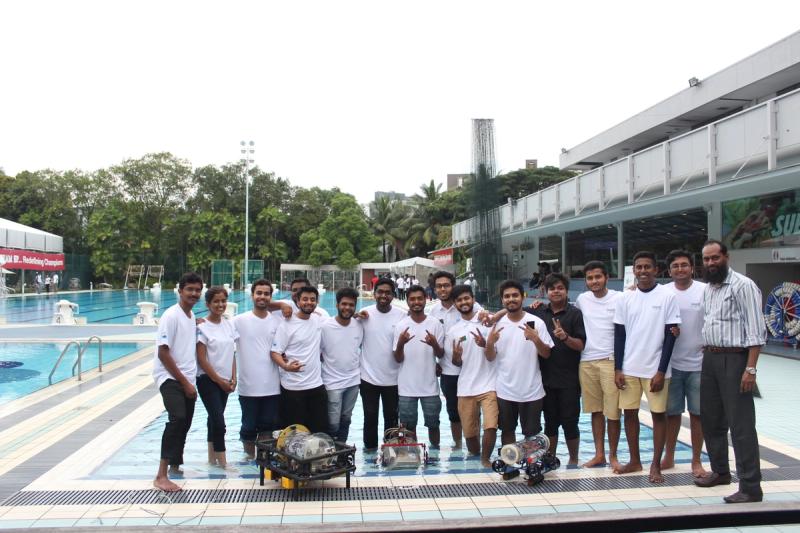
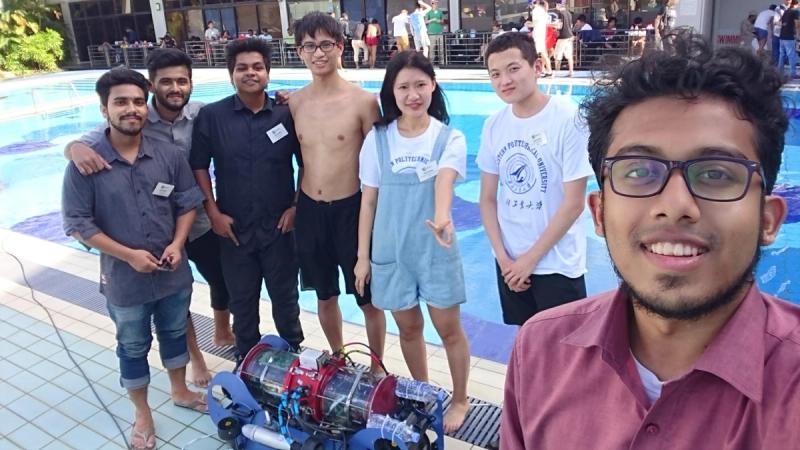
Tawfiq gave us two thrusters as a gift.
For many teams, two thrusters would have been a small part of a much larger system. For us, they felt enormous. We had just done all of this without proper thrusters. Even if we could not afford a full set later, two real ones gave us something to build around.
At that point, I was not thinking of a guaranteed Duburi v2. Funding was uncertain, and me and Sakib were getting close to the end of university. Arko would remain and could carry the team forward. We might still be around, but our roles would eventually change.
So we collected information without pretending we knew exactly what would happen next.
We Had Two Days Left
There was a gala night after the competition.
The Girl Who Understood Bangla
We had trouble finding the exact venue. On the way, we asked a girl for directions. She was a friend of some of the SAUVC volunteers and knew where the event was. She explained where to go, but we did not fully understand her answer. After walking away, I loudly told Arko in Bangla that the girl did not know anything and we should find the place ourselves.
A few minutes later, the same girl walked into the gala.
We started talking. She was from Kolkata.
Which meant she understood Bangla.
Neither of us mentioned what I had said on the road. I think that was the best outcome for everyone.
By then the competition was over, and Dr. Khalil had kept two extra days in Singapore so we could actually see the city.
After two nights with almost no sleep, the sensible thing was obvious: go back to the hotel and sleep.
We decided that would waste Singapore.
So we went back to Marina Bay. This time there were no drill motors running in our heads. We could finally look around properly, stay out late, and enjoy the version of Singapore we had barely noticed while the competition was still alive.
We desperately wanted to try the shared electric scooters. None of us had a usable international card. We scanned things, tried different ways to pay, and eventually accepted that Singapore had defeated us in one competition.
The next day we explored around the hotel. Somewhere behind the area we were staying, we realized we had wandered into a red-light district.
Nothing happened. We just walked through it. But even now we can joke with Dr. Khalil that he saved the university's money by putting us next to a brothel.
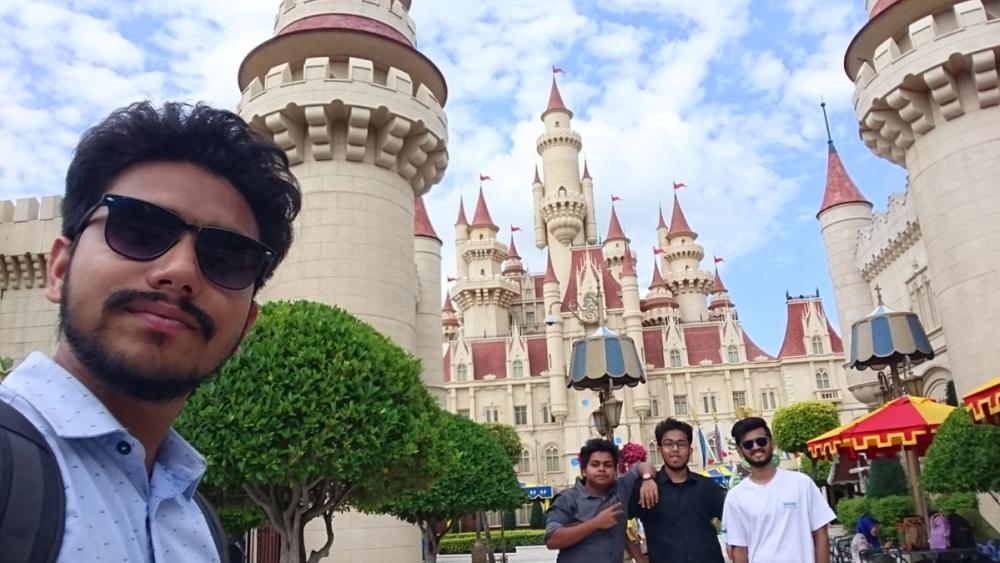
Ananto had also been pushing hard for us to visit Universal Studios Singapore. He arranged the tickets, and we went.
I am not normally someone who goes to amusement parks, but it was worth it.
On one roller coaster, Sakib ended up riding separately from us. The ride camera took a photo at exactly the moment the girl beside him was screaming and Sakib had turned his head to look at her. We kept that photo and made fun of him with it long after returning to Bangladesh.
We tried to use every remaining hour we had. After spending most of the trip looking at Singapore through the lens of a competition, we finally got to just walk around it.
Then we packed Duburi, the two gifted thrusters, and everything else we had collected, and flew back to Dhaka.
A group of students came to receive us at the airport.
A few days earlier, we had arrived in Singapore looking at the other teams and wishing we had their thrusters, their enclosures, their connectors, their trolleys, and their polished robots. We left knowing exactly how far behind we were in many of those things.
But we had also learned something else.
Duburi did not have the best mechanics, the best electronics, or the best software. It had three imperfect systems that had learned to work together. That had been enough to get us to Singapore, enough to finish 50 metres when stronger-looking robots could not, and enough to make us believe that the next version, if there was one, could be very different.
We had gone there to see whether our robot belonged in an international competition.
By the time we came home, that was no longer the question.